
Intensity Modulated Radiation Therapy
A New Technology to Improve Treatment of Pediatric Cancer Patients
Radiation therapy, chemotherapy and surgery constitute the three pillars of modern cancer treatment. Radiation therapy is used in the treatment of most types of pediatric malignancy, including leukemia, brain tumors, sarcoma, lymphoma, neuroblastoma and Wilms' tumor.
The Radiation Oncology Program at Children's Hospital Los Angeles is an internationally recognized leader in pediatric radiation oncology. Families from Asia, South America, the Middle East, and throughout the United States bring their children to Children's Hospital Los Angeles for the highest quality radiation therapy delivered in a compassionate, child-oriented environment.
Radiation is a highly potent local treatment that kills the tumor cells but can injure normal tissues that are in its path. The key to controlling tumors with radiation is targeting them with a high enough radiation dose over a short enough time period to kill every malignant cell. With the majority of childhood cancer patients now able to be cured of their disease, Children's Hospital Los Angeles is concerned with the long-term morbidity of our treatment. Children are particularly sensitive to the radiation doses needed to destroy their tumors, as their organs are still growing and developing. Their bone growth, kidney function, fertility, vision or intellectual development may be impacted in order to save their life. Late radiation side effects such as cataract formation, arteriosclerosis and new cancers can take decades to develop and can threaten our patients' lives all over again in their early adulthood.
The faculty of the Radiation Oncology Program at Children's Hospital Los Angeles has therefore pioneered methods of concentrating the radiation beam in the child's tumor, while sparing the child's surrounding normal tissues. In 1995, Children's Hospital Los Angeles introduced three-dimensional radiation therapy treatment planning, using computer-generated reconstructions of the patient's tumor, surrounding normal tissues and body contour.
As computer technology advanced, Children's Hospital Los Angeles instituted the delivery of conformal radiation therapy through multiple, non-coplanar, computer-shaped beams in 1998. In 1999, Children's Hospital Los Angeles co-developed the Head-Fix system and demonstrated that it improved the accuracy of radiation therapy delivery to children with brain tumors in a much more child-friendly manner than previous techniques. In February 2000, Children's Hospital Los Angeles installed the new Millennium Multileaf Collimator (MLC) on its linear accelerator. The MLC is a precision radiation beam shaping device consisting of 120 computer-driven motors, each controlling the movement of one 5-10 mm wide tungsten blade, or leaf. On January 4, 2001, Children's Hospital Los Angeles treated the first patient in the world with Intensity Modulated Radiation Therapy (IMRT) using the Nucletron ITP software and a Varian 120 leaf MLC.
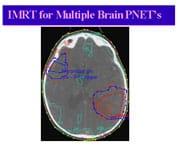
The MLC is currently used to more accurately conform the radiation beam to the shape of the child's tumor than was previously possible using hand-cast lead blocks. With the addition of newly developed computer software, the MLC can be made to do far more. In the past, the radiation dose given by each radiation beam to the normal tissues in front and on the sides of the child's tumor is was at least as high as the dose given to the tumor. Guided by computer instructions, the MLC dynamically varies the intensity of the radiation beam during each treatment to increase the radiation dose to the child's tumor while decreasing the dose to the normal tissues surrounding it. This process is called Intensity Modulated Radiation Therapy, or IMRT.
IMRT has been shown to safely permit intensification of the radiation dose to the tumor, thereby increasing the probability of eliminating the tumor. Simultaneously, the radiation dose to surrounding normal tissues is minimized, thereby diminishing the side effects of radiation both during and after treatment. The benefits of IMRT in reducing the degree of skin irritation, nausea, vomiting, fatigue, loss of appetite, diarrhea, and pain on urination during radiation therapy will be monitored. Reduction in long-term effects will be carefully measured as the patients mature.
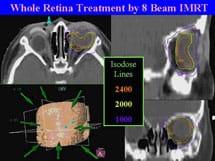
There are three basic components to the IMRT system: the MLC, the computer software to design the treatment and guide the MLC in its implementation, and the patient positioning system. The MLC consists of two opposing banks of 60 tungsten leaves each that define the size and shape of the irradiated area. Of the 120 leaves, the central 80 are 5mm wide and the peripheral 40 are 10mm wide. Each leaf is independently computer controlled to move through the field with a precision of 0.1 mm. Virtually any shape can be irradiated by the opening formed by these leaves. Inverse treatment planning software has been co-developed by the Children's Hospital Los Angeles, Radiation Oncology Program and a Dutch company, Nucletron, to calculate the optimal timing of movement and position of each of the 120 MLC leaves during the delivery of the radiation beams.
The software was cleared for use in patients by the United States Food and Drug Administration in December 1999. The software models the patient's tumor, normal tissues and body contours in three dimensions from CT scans. The radiation oncologist and radiation physicist then enter the desired radiation dose to the tumor and the maximum acceptable dose to each nearby normal tissue into the planning computer.
The computer next conducts a series of iterations comparing scores of treatment techniques involving an intricate combination of MLC leaf positions and time intervals at each position until it creates the one that most closely achieves the desired radiation dose distribution in each tissue. The chosen technique produces an intensity modulated dose pattern with varying radiation doses across the beam. Communication software transfers the selected treatment technique from the planning computer to the computer that controls the treatment setup and translates the plan into the code of the MLC computer.
The safe and effective delivery of IMRT demands that the radiation oncologist has the utmost confidence in the precision of the placement of the radiation fields, which were planned so carefully to avoid the healthy tissues surrounding the tumor. In many cases, we are positioning radiation doses just millimeters from sensitive normal organs. The ability to assure this degree of precision is obtained through the use of head or body immobilization devices specially designed by the Radiation Oncology Program staff, and state-of-the-art online electronic portal imaging to verify the proper placement of the radiation fields in real-time prior to daily treatment.
The IMRT system can achieve different goals according to the individual needs of the patient. The tumor dose can be maintained at the standard level while dramatically reducing the dose to the surrounding normal tissues. This would benefit patients with cancers such as Wilms' tumor and neuroblastoma, for which radiation is very effective but severely damages adjacent normal organs. We estimate that with IMRT the percentage of children developing spinal growth abnormalities following radiation therapy for these diseases would decrease from 80 percent to about 15 percent. The probability of kidney and liver dysfunction would decrease from 20 percent to nearly zero percent.
For patients with tumors that often re-grow after standard doses of radiation, such as sarcomas and brain tumors, with IMRT, the radiation dose to the tumor can be increased by 10-20 percent while maintaining or lowering the dose previously given to the surrounding normal tissues.
A particularly exciting option for difficult-to-control tumor types, such as brain tumors, is the delivery of intensive boost radiation doses to the tumor core each day while lower doses are given to the periphery. The entire radiation therapy course can be shortened from the conventional six to eight weeks to four to five weeks. The shorter treatment course will permit better integration with chemotherapy and may overcome the negative impact of rapid tumor cell proliferation as well as decrease patient inconvenience and acute toxicity. Shorter, more intense radiation treatments that do not produce additional damage to normal tissues have great promise for increasing the chance of curing difficult tumors.
IMRT provides a significantly better chance of surviving, free from both cancer and the morbidity of the treatment. The Radiation Oncology staff at Children's Hospital Los Angeles is currently using this revolutionary technology to treat children with cancers of the brain, head and neck, abdomen and pelvis.