Vaughn A. Starnes, MD
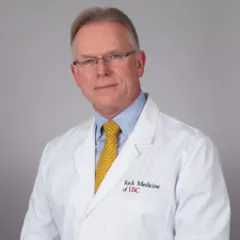
Vaughn A. Starnes, MD, is Distinguished Professor and Chairman of the Department of Surgery, H. Russell Smith Foundation Chair and Executive Director of the CardioVascular Thoracic Institute at the Keck School of Medicine of the University of Southern California.
He earned his medical degree from the University of North Carolina, Chapel Hill, and did his general surgery training at Vanderbilt University, where he also completed two years of research in cardiothoracic physiology and pharmacology.
Dr. Starnes completed two years at Stanford University as a resident in cardiovascular surgery, and one year as chief resident in cardiac transplantation. He accepted a fellowship in pediatric cardiovascular surgery at the Hospital for Sick Children in London. When he returned to Stanford, he was appointed director of Stanford's heart-lung transplantation program. In 1990, Dr. Starnes performed the world's first lobar transplant using a lung segment from a living donor. Three years later, he performed the first live-donor, double-lobar lung transplant on a patient with cystic fibrosis. The operation involved taking lung tissue from each parent and transplanting it into their child.
He joined USC in July 1992 and was appointed Chairman of the Department of Cardiothoracic Surgery in 1997. Dr. Starnes has an ongoing interest in congenital heart disease, heart, lung, heart-lung and living related lung transplantation, coronary bypass grafting, and repair and replacement of the valves of the heart. He is also involved in research, helping develop gene therapy techniques to address the problem of restenosis following balloon angioplasty.
As the founding executive director of the USC CardioVascular Thoracic Institute, Dr. Starnes has built an innovative, interdisciplinary powerhouse, comprised of clinicians and basic scientists who are exploring better and more innovative ways of treating heart disease. Under his leadership, USC surgeons have conducted more than 15, 000 open heart surgeries to repair and replace valves or create coronary artery bypasses, and more than 10,000 surgeries for diseases of the lungs, esophagus and chest wall.
He and his surgical team also performed Southern California's first robotic heart operation in 2001 as part of the clinical trial evaluating the use of a remote surgical system. In addition to his clinical work, Dr. Starnes is a distinguished researcher. He has an ongoing interest in many areas of research, including congenital heart disease, cadaveric and live-donor organ transplantation, coronary bypass grafting, and repair and replacement of heart valves.
He is also involved in bench research helping develop gene therapy techniques to address problems that occur after balloon angioplasty procedures. Dr. Starnes is currently investigating the use of gene therapy to prevent scarring following heart surgery.
He is also involved in a clinical trial using robotic surgery technology for cardiothoracic surgery.
Also, Dr. Starnes is the Vice President of the American Association for Thoracic Surgery. He is the 100th president of the AATS in 2019-2020.
Education
University of North Carolina
Vanderbilt University Medical Center; Surgical Internship
Vanderbilt University Medical Center - Pharmacology/Surgery Residency; Stanford University Hospital - Cardiac Transplantation Residency; Stanford University Hospital - Cardiovascular Surgery Residency; Stanford University Hospital - Thoracic Surgery
Pediatric Cardiovascular Surgery, Hospital for Sick Children, London
Accomplishments
Congenital Heart Surgery and Thoracic Surgery
Publications
Reduced pleural drainage, length of stay, and readmissions using a modified Fontan management protocol.
Pike NA, Okuhara CA, Toyama J, Gross BP, Wells WJ, Starnes VA.
J Thorac Cardiovasc Surg. 2015 Sep;150(3):481-7. doi: 10.1016/j.jtcvs.2015.06.042. Epub 2015 Jun 26.
Arterioplasty for Right Ventricular Outflow Tract Obstruction After Arterial Switch Is a Durable Procedure.
Wiggins LM, Kumar SR, Starnes VA, Wells WJ.
Ann Thorac Surg. 2015 Jul;100(1):122-7; discussion 127-8. doi: 10.1016/j.athoracsur.2015.02.086. Epub 2015 Apr 25.
Age-Related Outcomes of the Ross Procedure Over 20 Years.
Bansal N, Kumar SR, Baker CJ, Lemus R, Wells WJ, Starnes VA.
Ann Thorac Surg. 2015 Jun;99(6):2077-83; discussion 2084-5. doi: 10.1016/j.athoracsur.2015.02.066. Epub 2015 Apr 25.
Survival and quality of life for children with end-stage heart failure who are not candidates for cardiac transplant.
Sabati AA, Szmuszkovicz JR, Herrington C, Hermes M, Mahmoud HA, Phei Wee C, Starnes VA, Menteer J.
J Heart Lung Transplant. 2015 Jul;34(7):906-11. doi: 10.1016/j.healun.2015.01.006. Epub 2015 Jan 16.
A comparison of aortic valve replacement via an anterior right minithoracotomy with standard sternotomy: a propensity score analysis of 492 patients†
Bowdish ME, Hui DS, Cleveland JD, Mack WJ, Sinha R, Ranjan R, Cohen RG, Baker CJ, Cunningham MJ, Barr ML, Starnes VA.
Eur J Cardiothorac Surg. 2015 Mar 6. pii: ezv038. [Epub ahead of print]
Muralidaran A, Kim RW, Kopf GS, Pietris NP, Weeks BP, Starnes VA, Shinoka T. (2012) Modified Starnes procedure in a neonate with severe tricuspid regurgitation. Ann Thorac Surg 93(2):658-9
Cunningham MJ, Berberian CE, Starnes VA. (2011) Is transthoracic minimally invasive aortic valve replacement too time-consuming for the busy cardiac surgeon? Innovations: Technology and Techniques in Cardiothoracic and Vascular Surgery. 6(1):10-14.
Kane LC, Wells WJ, Starnes VA. (2011) A novel reconstruction of the left superior vena cava. J Thorac Cardiovasc Surg Nov 19.
Kim J, Wu Q, Zhang Y, Wiens KM, Huang Y, Rubin N, Shimada H, Handin RI, Chao MY, Tuan TL, Starnes VA, Lien CL. (2010) PDGF signaling is required for epicardial function and blood vessel formation in regenerating zebrafish hearts. Proc Nathl Acad Sci USA 107(40):17206-10.
Research
- Adult acquired heart disease
- Heart, heart-lung and lung transplantation
- Congenital heart surgery
- Tissue engineering
Media
Yahoo! Finance - Children’s Hospital Los Angeles Announces New Heart Institute Faculty
KCBS/KCAL - Jeff Crooyman And 16-Month-Old Son Bryce Share Special Bond And The Same Surgeon
CBS News - Rare Tiny Heart Procedure Saves Tiny Newborn’s Life
Outlook Newspapers - CHLA Strives for Hybrid Surgery
ABC News- 'Young and Restless' Actor to Have Heart Surgery
Jimmy Kimmel Live! — Jimmy Kimmel Reveals Details of His Son's Birth and Heart Disease
PEOPLE.com - 100 Reasons Why We Love America
CNN – Ellen DeGeneres surprises Jimmy Kimmel
CHLA Press Release
CHLA Blog
How Will New Pediatric Heart Surgery Guidelines Impact Care?
Children’s Hospital Los Angeles to Host Symposium on Congenital Aortic Valve Stenosis
What Anatomic Factors Impact Complete Atrioventricular Canal Defects?
Born With Ebstein’s Anomaly, Jaxon Now Has a Normal Heart
From Severe Ebstein Anomaly to a Normal Heart
From CHLA Heart Patient to CHLA Heart Institute Nurse
A World of Good: Baby Ali, born in Qatar, Has His Heart Rebuilt at CHLA
Children’s Hospital Los Angeles Performs World’s First Implant of a Novel Stent for Babies
Achieving Excellence in Infant Mitral Valve Repairs
A Father and Son, and the Doctor Who Saved Them Both
What Is the Role of the Neonatal Ross?
From Open Heart to Bright Future
A Model of Success in Ebstein Anomaly
4650 Sunset Blvd.
Los Angeles, CA 90027
United States